

 According to search technology firm Lucidworks, businesses typically only analyse around 10 per cent of the data they collect.
Category Archives: digital organization
Principles of Service Management
In the time of the ITIL update to version 3 I was involved with updating the ITIL training materials at Getronics PinkRoccade (former PinkElephant). One of the discussions we had was about the underlying principles of ITIL. These principles were not made very explicit in the books; their existence were mostly only mentioned in the introductions. I did a search through all the books and distilled some more implicit principles into a slide that we started using in the introduction in all the different ITIL courses at that time.
Recently, with all the discussions about the differences and similarities between ITIL, DevOps, SIAM, etc., I was wondering if these principles were still relevant. In his guest blog on the ITSM Review. ‘Why is this content at the end of the conference? This should be a Keynote topic!’ – CEO” Paul Wilkinson refers to his guiding principles on Service Management:
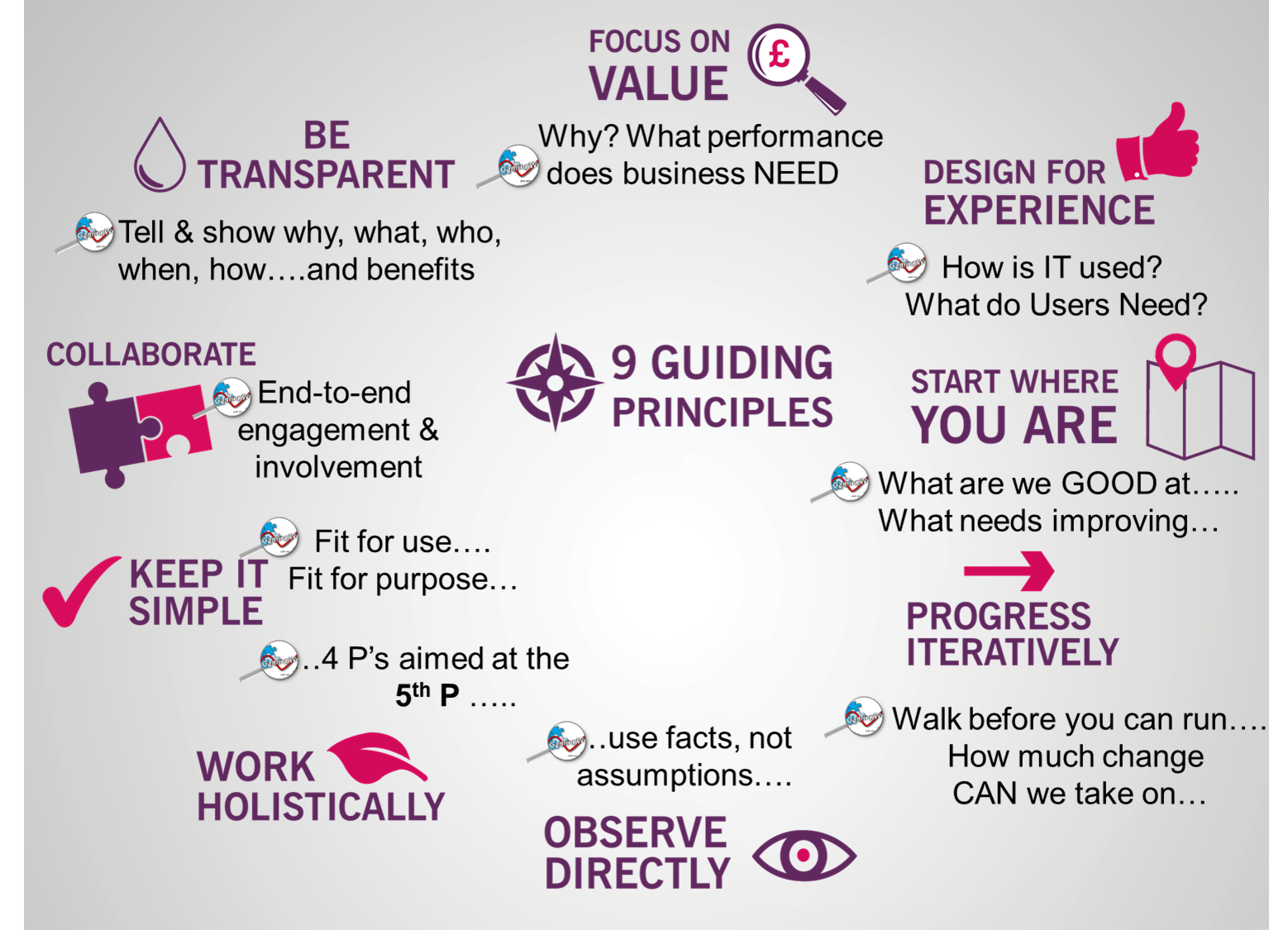
These principles refer directly to Attitude and Behavior of the IT workers delivering services and value to the business. The principles we found so many years ago refer to the organization of IT delivering the services as well and I feel they complement Paul’s principles as well as adding another perspective.
- Agency principle
Service providers are made accountable to deliver services (value and business outcome) and are enabled to take responsibility for the costs and risks. A contract can be made to specify the value (price) against the costs and risks within the boundaries of laws and regulations.
Often IT departments are not enabled to truly take the responsibility for the services they provide. They have no authority over their budget and their spending, they can not negotiate contracts with suppliers and they have no possibilities to hire the staff they need. The first step therefore to make IT departments (managers/directors) accountable is to enable them to take responsibility. - Balance Principle
It is a common thread in IT service delivery that IT engineers tend to look at the product and the business look at its use. “How does it work?” against “What can you do with it?”. Sometimes the IT view tends to be too strong and the focus is on technology for technology’s sake. On other occasions the business view tend to ask for impossible and impractical technical solutions. In order to deliver the optimal services there should be a balance between the Internal IT view versus the external Business View - Service Measurement principle
There is a strong emphasis on metrics and performance indicators in service management. There is a need to show to the business that IT services deliver value as promised by the IT organization. This need leads to a continual monitoring and measuring of service delivery and the underlying processes. To make use of these data a service management system should be in place. - System Principle
There are many definitions for a system (unfortunately) and in this case a system is an holistic and integrated function to deliver services. A system contains people, processes (activities), tools and instruments, relations, contracts and other concepts (4P’s) to perform (5th P) and deliver value to the business. - IT Service Lifecycle Principle
Service delivery is a continuous process of design, implement, operate and improve. Continual Service Improvement is not a separate process or activity but a core element of managing the service provider as a whole. This enables an iterative and incremental approach to service improvements in line with DevOps and Agile IT. - Knowledge Management Principle
This is in practice on of the most fundamental and difficult principles of service management: to make sure that the right information and knowledge is provided to the right people on the right time. This asks for an organization that keeps on sharing and learning, It asks for feedback from the users and the business. For people that listen with empathy, reflection and patience. For systems that enable to share information as well as keep the amount of information manageable.
A Series of Symbiotic Events – part 2
 The real problem isn’t that people don’t create a plan for event management, but that the plan they create does not consider the right relationships.
A Series of Symbiotic Events – part 1
 event management should be the process nominated for best supporting actor, since in reality it is part of the groundwork for the one Main Event
Why Software License Optimisation is the Key to IT Service Management
To meet the challenge of delivering IT in this new environment, smart organisations are looking to implement IT service management (ITSM).
Source: Why Software License Optimisation is the Key to IT Service Management
‘Why is this content at the end of the conference? This should be a Keynote topic!’ – CEO
Following the awesomeness of #PINK16 last week, we were lucky to bump into @gamingpaul! Paul very kindly agreed to write a guest blog for us on his session, so here it is in all it’s glory! ‘Why is this content at the end of the conference? This should be a Keynote topic!’ – […]
Source: Guest Blog from PINK16: Paul Wilkinson of GamingWorks – The ITSM Review
Improving Today’s Dynamic IT with Machine Learning as a Formal & Agile Approach to ITSM
The way to achieve the best of both worlds is through the standardisation and predictability of a formal (but agile!) approach to ITSM.
Case study: How ITIL has helped Essex keep IT aligned with council goals
 Essex County Council has undergone an IT transformation to improve the credibility of its IT and achieve ISO 27001 accreditation.
Source: Case study: How ITIL has helped Essex keep IT aligned with council goals
The state of the cloud in 2016: DevOps, Docker momentum grows as hybrid hits its stride
Hybrid cloud adoption has grown significantly while DevOps and Docker uptake continues to explode, according to the latest RightScale State of the Cloud research report.
SMA Business Relationship Management is NOT about services

If you want to be a strategic partner, your Business Relationship Management capability must be able to stay focused on value, NOT on services.
Source: SMA Business Relationship Management is NOT about services
 Idwell on Service Management